Posts

Beetles, Butterflies and Birds

Image
After having a break from my blog in July I am back! Not far from where I live, just  below the Malvern Hills,  is  Hollybed Farm Meadows, a   Worcestershire Wildlife Trust nature  reserve. It was acquired by the trust in 2013 when it was used a horse grazing field - now it is a beautiful series of wildflower meadows, woodland and hedgerow. One of the recurring plants throughout the reserve is Field Scabious which this Painted Lady is clearly enjoying! The Painted Lady's presence in the UK is unpredictable; they are a migrant here and some years many will turn up and in others barely any! Perhaps as the climate and weather changes we might see more of these beautiful butterflies. Its not just butterflies that like Field Scabious, these flower beetles (the one at the back is a female Thick-legged beetle but I'm not sure about the one at the front) were probably looking for pollen to eat. As I walked along the edge of one of the meadows I noticed a  Marb...

Wildlife in Dorset and Gloucestershire!

Image
  I've recently been down to Dorset in search of wildlife that frequent the numerous heaths that are in the area. One of these species is the beautiful Dartford Warbler ( Sylvia undata ) which needs these heaths to be able to breed and survive. In the 1960's, Dartford Warbler numbers dropped to only a few pairs in the whole of the UK, due to very cold winters, habitat and insect loss. However, the RSPB has been working very hard to get these beautiful birds back to safe numbers and 50 years on there are now 3,200 breeding pairs in the UK. The Dartford above was taken at RSPB Arne on one of the infrequent sunny spells I had on the day!  After hearing the 'churring' contact call of one, I sat and waited for a while to see if it would come any closer. I was rewarded with lovely views of it feeding amongst the heather, gorse and small pine trees.   Then, 3 more appeared! They were flying in and out of one patch of heather with food then coming back out again without food...

Birding in Powys

Image
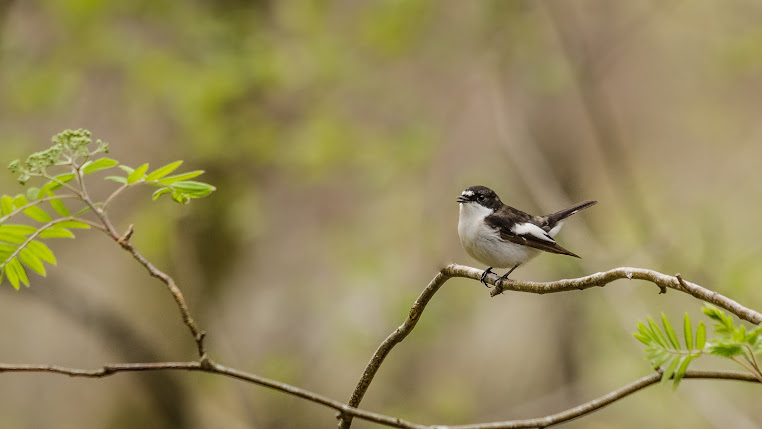
I was recently in Radnorshire, Powys, hoping to catch a glimpse of some spring migrants.  Radnorshire has some beautiful and amazing habitats - from ancient woodland, moorland, rivers, heathland, meadows and  also Celtic  rainforest; s o rare, it is considered to be even more threatened than tropical rainforest. My first location was the Elan Valley Celtic Rainforest which supports over 200 species of lichen and plant species and also a wide variety of birds. One of these birds is the beautiful Pied Flycatcher( Ficedula hypoleuca )   which nest in the large number of nest box's that the Elan Valley Trust provide for them. Walking up the steep wooded sloops of the valley I heard the calls of Willow Warbler and Chiffchaff, 2 other spring migrants who arrived earlier this month. After walking for only a few minutes I saw my first ever Pied Flycatcher flitting around in a low shrub. I was so pleased when I saw there were also 2 more darting in and out of the tree canopy....

Birding in North Wales

Image
I was recently staying at the Youth Hostel in Conwy, North Wales, the weather was on our side with bright sun and temperatures reaching 15c. Above is my favourite photo from the trip - a male Linnet in the sand dunes on RSPB Point of Ayr, Dee Estuary.  RSPB Point of Ayr is a fantastic nature reserve with sand dunes, beach, saltmarsh and reedbed.  There were many Meadow Pipits  ( Anthus pratensis )  flitting about in the dunes singing as they flew; this one perched really close by on a Evening Primrose stem. Distinguishing Meadow Pipits and Skylarks  ( Alauda arvensis ) can be quite tricky  though there are some ways you can tell them apart, the most reliable way is the size; Meadow Pipits  are quite a bit smaller than Skylarks which are taller and have a longer body.  Skylarks have a crest (which is sometimes not visible) and although plumage is quite similar they are  usually lighter. Here's a Skylark for comparison and you can see it h...

Birding at WWT Slimbridge!

Image
  I had seen recent reports of a Glossy Ibis at WWT Slimbridge and was lucky enough to see it when I visited  with some friends  a few weeks ago.  I noticed a photographer on the canal towpath by the entrance fields  and walked slowly to where he was -  WOO HOO!! there was the Glossy Ibis probing in the mud. Even though it was an overcast day with barely any sun I could  still   see the purple and maroon sheen on its feathers. Glossy Ibis ( Plegadis falcinellus ) a re native to the coasts of America, Mexico and parts of northern South America and very occasionally, end up here in the UK. They use their long curved bill to probe into the mud, feeling for prey such as leeches, earthworms, marine worms, dragonflies, crickets, grasshoppers, many species of beetle, crabs, molluscs snails, fish, frogs, toads and newts. From another hide this Avocet was wading in the shallow water and feeding; they swing their upturned bill under the surface of the water...

Devon Bird Bonanza!

Image
 Another trip down to Devon... ...in search of winter wading birds! This was my favourite shot of the trip - and its not of a wader! Its a male Kestrel, taken at Dawlish Warren National Nature Reserve. I spotted him hovering some distance away, he then flew off and perched right at the top of a tree. It was lovely to see its plumage up close. This Ringed Plover was on the Otter Estuary in the town of Budleigh Salterton, where I was staying.  I took many photos of it but this was my favourite as it shows movement. The Otter Estuary Nature Reserve is also classified as a SSSI and covers 57 acres of tidal saltmarsh and mudflats. It's a very important place for wildlife in the area and at the moment the Lower Otter Restoration Project has started work. There's some more information on this new project here: http://www.lowerotterrestorationproject.co.uk/ Here's a Redshank - taken on the same day and location. And a Curlew! I have never managed to get this close to one before so ...