Posts

Birding in Powys

Image
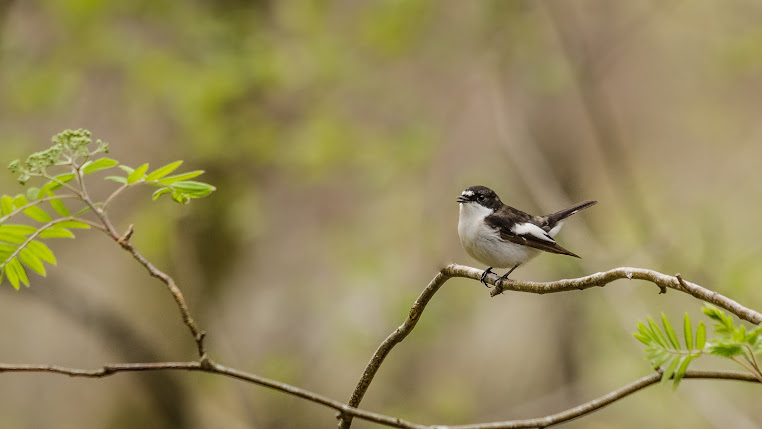
I was recently in Radnorshire, Powys, hoping to catch a glimpse of some spring migrants.  Radnorshire has some beautiful and amazing habitats - from ancient woodland, moorland, rivers, heathland, meadows and  also Celtic  rainforest; s o rare, it is considered to be even more threatened than tropical rainforest. My first location was the Elan Valley Celtic Rainforest which supports over 200 species of lichen and plant species and also a wide variety of birds. One of these birds is the beautiful Pied Flycatcher( Ficedula hypoleuca )   which nest in the large number of nest box's that the Elan Valley Trust provide for them. Walking up the steep wooded sloops of the valley I heard the calls of Willow Warbler and Chiffchaff, 2 other spring migrants who arrived earlier this month. After walking for only a few minutes I saw my first ever Pied Flycatcher flitting around in a low shrub. I was so pleased when I saw there were also 2 more darting in and out of the tree canopy....

Birding in North Wales

Image
I was recently staying at the Youth Hostel in Conwy, North Wales, the weather was on our side with bright sun and temperatures reaching 15c. Above is my favourite photo from the trip - a male Linnet in the sand dunes on RSPB Point of Ayr, Dee Estuary.  RSPB Point of Ayr is a fantastic nature reserve with sand dunes, beach, saltmarsh and reedbed.  There were many Meadow Pipits  ( Anthus pratensis )  flitting about in the dunes singing as they flew; this one perched really close by on a Evening Primrose stem. Distinguishing Meadow Pipits and Skylarks  ( Alauda arvensis ) can be quite tricky  though there are some ways you can tell them apart, the most reliable way is the size; Meadow Pipits  are quite a bit smaller than Skylarks which are taller and have a longer body.  Skylarks have a crest (which is sometimes not visible) and although plumage is quite similar they are  usually lighter. Here's a Skylark for comparison and you can see it h...

Birding at WWT Slimbridge!

Image
  I had seen recent reports of a Glossy Ibis at WWT Slimbridge and was lucky enough to see it when I visited  with some friends  a few weeks ago.  I noticed a photographer on the canal towpath by the entrance fields  and walked slowly to where he was -  WOO HOO!! there was the Glossy Ibis probing in the mud. Even though it was an overcast day with barely any sun I could  still   see the purple and maroon sheen on its feathers. Glossy Ibis ( Plegadis falcinellus ) a re native to the coasts of America, Mexico and parts of northern South America and very occasionally, end up here in the UK. They use their long curved bill to probe into the mud, feeling for prey such as leeches, earthworms, marine worms, dragonflies, crickets, grasshoppers, many species of beetle, crabs, molluscs snails, fish, frogs, toads and newts. From another hide this Avocet was wading in the shallow water and feeding; they swing their upturned bill under the surface of the water...

Devon Bird Bonanza!

Image
 Another trip down to Devon... ...in search of winter wading birds! This was my favourite shot of the trip - and its not of a wader! Its a male Kestrel, taken at Dawlish Warren National Nature Reserve. I spotted him hovering some distance away, he then flew off and perched right at the top of a tree. It was lovely to see its plumage up close. This Ringed Plover was on the Otter Estuary in the town of Budleigh Salterton, where I was staying.  I took many photos of it but this was my favourite as it shows movement. The Otter Estuary Nature Reserve is also classified as a SSSI and covers 57 acres of tidal saltmarsh and mudflats. It's a very important place for wildlife in the area and at the moment the Lower Otter Restoration Project has started work. There's some more information on this new project here: http://www.lowerotterrestorationproject.co.uk/ Here's a Redshank - taken on the same day and location. And a Curlew! I have never managed to get this close to one before so ...

Birthday Birding!

Image
  I had a wonderful birthday day-out with some friends at WWT Slimbridge, Gloucestershire, a few days ago.  We arrived there at the leisurely time of 11.30am and set off in search of birds! This Pigeon was my first photo, taken only a few steps away from the entrance. I was amazed by its  orange eye and t he violet-green colours on its neck. Looking out onto a huge pond from  one of the hides I saw  Tufted Duck, Mallard and Teal.  A beautiful male Pintail duck swam very close by, I like the ripples in the water. Here are 3 of the lovely male Tufted Duck. As I sat watching the waterfowl a Shelduck  ( Tadorna tadorna )  drifted into view. Some people may think they are geese because of their size!  There are about 15,000 breeding pairs in the UK though their numbers are boosted in the winter from birds coming in from Scandinavia, bringing the UK wintering population size to 61,000.  Ahhh! I know rats can be an annoyance at times but these ...

Snow Buntings

Image
I decided to go back to the Worcestershire Beacon a few days ago to try and get some better views of Snow Bunting which I briefly spotted in November.  After a walk round the hills I started to give up hope when I spotted birdwatchers looking at a patch in the grass and saw the illusive bunting! I got down low and after a while it wandered closer to me until it was about 2 feet away from me!  Snow Bunting ( Plectrophenax nivalis ) are amazing birds; most breed in the Arctic, Greenland and Scandinavia but about 60 pairs breed in a very small spot of the Highlands of Scotland. However, during the winter around 10,000 to 15,000 birds come to the coasts around England, Wales, Ireland and more inland in Scotland. They mainly feed on seeds, insects and plants and can live up to 9 years and weigh up to 40g.  I think that they may stay a little bit longer on the Worcestershire Beacon, but they will almost certainly be gone by March.

Buzzards and Blue tits!

Image
Here I am at a friends garden where there's an  old apple tree with a few bird feeders, frequently used by Blue tits . I stood just in front of the feeders and waited for the birds to get used to me. As they hopped down the lichen covered twigs to the feeder I took these shots...   You can't really get much cuter than that! At the moment Blue tits are having a 'restock' with more coming in to the UK from Scandinavia to escape the very cold and harsh winters over there. By Spring all of the Blue tits which came from Scandinavia will have gone back to breed. We will still have the resident Blue tits which stay all year round.  Blue tits are so acrobatic, they are amazing little birds. This Buzzard ( Buteo buteo ) flew right over me   and looked down just at the right moment. Here's a funny photo of one of the Blue tits to finish off this blog post!

Devon Birds...

Image
  A trip down to Devon... I  saw a group of Turnstones on some rocks really close by some steps leading onto Sidmouth beach. I walked slowly down, until I was as close as I could get to them, without falling in the sea! I really like the waves and stray water droplets  around it. RSPB Bowling Green Marshes, a brilliant nature reserve which backs onto the Exe Estuary -  walking to one of the hides I spotted this Little Egret  on the mud flats.  Little Egrets are not to be confused with the Great White Egret. (I've seen a few wildlife presenters get it wrong on TV!) GWE are much larger, standing at double the height as a Grey Heron and generally have a yellow beak, whereas the LE is half that size, has a black beak and is much more common. Here are some more pics from the trip, not the best but I thought were still worth putting in... Chiffchaff at Bowling Green Marshes.  And a beautiful Kingfisher, also taken at Seaton Wetlands.